Saturday, 18 February 2012
Delay in Project
The dissertation project has come to a stop for a couple of weeks while finishing off some of the other projects which are due in during this time. The portfolio project and design masterclass have priority for now and I feel that I can spare the time to pause the dissertation and concentrate wholly on these two projects instead.

Thursday, 9 February 2012
Final Dragon Concept
I realised that I hadn't posted the final dragon design that I created.
The initial sketch for my final design took quite a while to process. Due to the many options and looks I had come across during my research, it was hard to make up my mind which would look and work best. I also had to keep in mind my own abilities/limits and not go over-board with the details, and keep the geometry clean, tidy and simple.
I also had to make sure that the dragon I was creating would be anatomically functional as well, and not just decorative, as this will make the dragon more realistic when rendered and easier to model. Details such as eye position, legs/toes and wing structure was very important.
After making sure everything looked all right with the pencil sketch, I scanned the image and cleaned up the lines in Photoshop. At the same time, I made some adjustments to the sketch and measured the front/side views to match perfectly for when used as blueprints in 3ds Max later.


I also decided to colour the dragon in Photoshop to give me an idea of what kind of colour palette to use later on. For this I started off with the same sketches as earlier, based on the re-touched line-art.

After many long hours, I finished the colouring process, and although it is just an idea, it could well be the final design too.
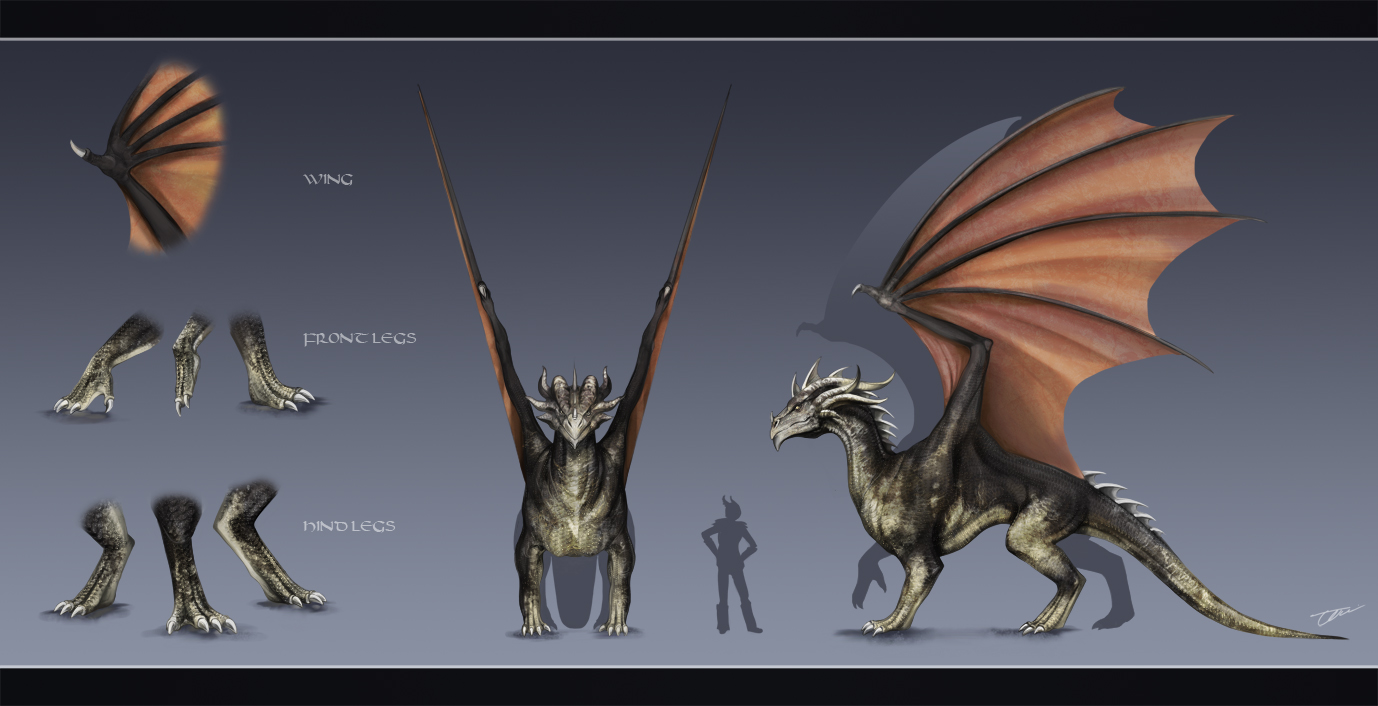
The body would mainly be a dark-ish colour, either black, dark grey or brown. Specks of beige or light grey/yellow would cover the "softer" areas (head, throat, belly, tail and legs). Horns would be light grey with some darker areas, and the inside of the wing is a rusty orange/brown/red colour. The outside of the wing is the same colour as the dragon itself. Eyes would be amber or golden to match the markings. Scales would cover the whole body apart from the wing arm and membrane. The dragon would be twice the size of a full-grown man, and four times his length with its wings straight up. The wing is approximately the size of the dragon itself.

The initial sketch for my final design took quite a while to process. Due to the many options and looks I had come across during my research, it was hard to make up my mind which would look and work best. I also had to keep in mind my own abilities/limits and not go over-board with the details, and keep the geometry clean, tidy and simple.
I also had to make sure that the dragon I was creating would be anatomically functional as well, and not just decorative, as this will make the dragon more realistic when rendered and easier to model. Details such as eye position, legs/toes and wing structure was very important.
 |
| The dragon is well balanced in size and bulk. |

 |
| Front view of dragon based on the side sketch. |
 |
| Sketches of front/hind legs. Each foot has 4 fingers/toes, apart from the wing which has 5. |
After making sure everything looked all right with the pencil sketch, I scanned the image and cleaned up the lines in Photoshop. At the same time, I made some adjustments to the sketch and measured the front/side views to match perfectly for when used as blueprints in 3ds Max later.


I also decided to colour the dragon in Photoshop to give me an idea of what kind of colour palette to use later on. For this I started off with the same sketches as earlier, based on the re-touched line-art.

After many long hours, I finished the colouring process, and although it is just an idea, it could well be the final design too.
The body would mainly be a dark-ish colour, either black, dark grey or brown. Specks of beige or light grey/yellow would cover the "softer" areas (head, throat, belly, tail and legs). Horns would be light grey with some darker areas, and the inside of the wing is a rusty orange/brown/red colour. The outside of the wing is the same colour as the dragon itself. Eyes would be amber or golden to match the markings. Scales would cover the whole body apart from the wing arm and membrane. The dragon would be twice the size of a full-grown man, and four times his length with its wings straight up. The wing is approximately the size of the dragon itself.
 |
| Close up view of some of the details. |
Tuesday, 24 January 2012
Concepts
Many of the concepts were inspired by already existing drawings of dragons. Due to the huge amount of dragon types, hardly any dragon is the same as the previous one, and the number of different varieties is mind-boggling.
During my conceptual research stage, I came across several sub-categories of dragons. Of course, the main ones being the archetypes, Western and Eastern dragons, but my search for inspiration branched to include only the Western dragons, as they are the ones that are more natural, traditional and "logical". Within the category of Western dragons, I could easily make out a few varieties that seem to belong to the same sort of group. I call these traditional, modern and elemental dragons.
Traditional dragons:
The stereotypical dragon that the majority of people think of when they hear the word "dragon". A large, majestic creature with a stream-like figure, both agile and strong at the same time. Upon a long and slim neck rests a chiselled narrow head with an arrow-like and almost beak-like snout. The head is crowned by horns that are sometimes connected by a membrane to form a very fin-like appearance. These "fins" can sometimes continue along the spine down to the tip of the tail. The legs of these dragons are long and shaped like felines or canines, and overall, the appearance is very feline - elegant, curved and deadly.
Modern dragons:
I've taken the liberty of naming these dragons "modern" because they have only recently made their appearance in art and games and differ quite a lot from the stereotypical dragon. The body is more stout and compact, with short, sturdy legs and hard skin. The neck is also a lot shorter, and the body is fairly broad compared to the stream-like features of its traditional cousin. The head is characterised with a small, deep-set eyes and a strong, jaw with a clear under-bite. This type of dragon is more reptile-like in its appearance, and the head remind a lot of a dinosaur's.
Elemental dragons:
The final type of dragons is the elemental dragon. These dragons don't share any common features with each other, but are fully or partly covered by a certain element, such as fire, ice or stone. Ice dragons are the most common of the group, where the dragon itself is covered in white scales and icicle spikes, and the wings are often only decorative rather than practical. Since these types of dragons don't follow the principle anatomy research, I haven't bothered designing any.
HEAD STUDY
Apart from anatomical studies, the first concepts I made were of the dragon's head. These were partly based on existing ideas and partly made up. Gathering inspiration for my final design is just as important as references make up a huge part of the conceptual process. These helped me greatly in getting a grasp of the large variety of dragons available as well as giving me plenty of ideas what's available for my final design.


QUICK DIGITAL CONCEPTS
The following step was to quickly draw down some initial concepts of full-body dragons. I wanted to get a feel of what it felt like to do these fast concept ideas, so after watching a few videos of the process I tried it myself. Although not as fast as I should have been, I enjoyed the rough greyscale figure/pose-focused exercise.

FULL-BODY CONCEPTS
After doing my quick concept ideas, I decided to go back to paper and think more carefully about the design of the actual body for the dragon. These were shaded, unlike the heads, to give a better idea of the muscles and overall body definition. I tried to include several different builds, both the feline and reptile ones to get a feel of which felt more natural. Because I wanted to concentrate more on the actual body, I didn't add any details or decorative spikes that would get in the way.


The final design of my dragon (for now) will be based on a combination of these builds and heads, with sufficient enough detail to make it interesting but not over-done. Although it is at this point hard to tell for sure how accurate the initial design will be to the final design, and it may well change during the 3D process.
Research
The research process was a tricky one, not because there was an insufficient amount, but because of the huge range of contradicting material that's available. It quickly became obvious that different people in different cultures view dragons very differently, the main ones being Oriental and Western stereotypes. Authors of various genres and makers of games have set their own stereotypes of dragons. These include everything from dragons being the creatures of ultimate evil, guardians of treasures, beasts tamed for riding controlled by magic, loyal companions, pets or even soul-mates who are telepathically and mentally bonded with their riders. Due to the large amounts of conceptions, it's hard to pin-point exactly what the dragons' standing in society is; is it a monster or a friend? Do dragons live alone and fight others on sight, or do they live in huge social clans with very exquisite rankings and bonds? The answer will be different depending on who you ask.
The cultural and social differences aside, most dragons share a few common features, such as reptilian features and scales, wings and/or the ability to fly (many types of dragons don't actually possess wings, but can still fly), enormous strength and noxious/fire breath. The anatomy of most dragons is unexplainable and illogic, and some people have gone to great lengths to search for scientific answers to the dragons anatomical build and it's ability to fly and breathe fire. These researches claim, for example, that because of the large muscles needed for flight, the dragon would in fact not be able to run very well, as it wouldn't be built for this purpose. The wings, which in fact is another set of arms complete with five fingers, need to be connected at the far back of the dragons body to give the wing membranes a large enough surface area to keep the dragon airborne and allow it to fly horizontally. The physics of proportion, or more commonly called "Physics of Lilliput" claim that the dragons would in fact have to be fairly small creatures (1 to 10 foot) in order to be able to fly at all. If you, for example, had a perfectly proportionally functional dragon that could fly, and decided that you wanted to enlarge the dragon ten times and keep the proportions, the length of the dragon would be ten times as long, the surface area a hundred times larger and he will weight a thousand times more than before because of this. Because his wings give him the ability to fly, he will be unable to fly because of his lack of lift power in comparison to his new area/volume.
Dragons are also a very tricky creature to classify because they don't belong solely to one class of animals, but more a combination of several, or even a class of their own. They can't be reptiles, since they are warm blooded and active; they can't be mammals because they lay eggs and don't produce milk, and they can't be birds as they have scales and six members. They do possess traits of each of these classes though:
Below are a few pages of compiled research. The research is based on the most logical and scientific explanations on how dragons could have looked and behaved had they existed. Special credits to Draconian and Dragnix for the consistent information.


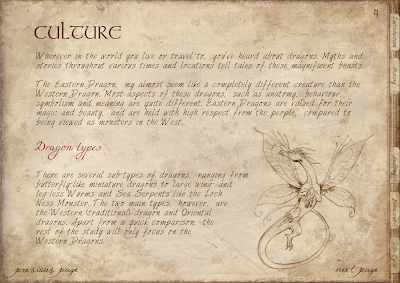


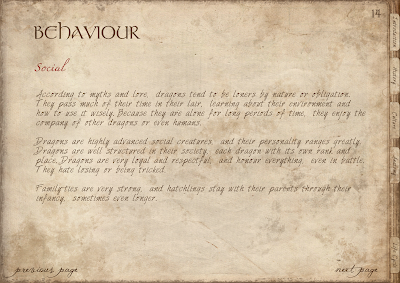


The cultural and social differences aside, most dragons share a few common features, such as reptilian features and scales, wings and/or the ability to fly (many types of dragons don't actually possess wings, but can still fly), enormous strength and noxious/fire breath. The anatomy of most dragons is unexplainable and illogic, and some people have gone to great lengths to search for scientific answers to the dragons anatomical build and it's ability to fly and breathe fire. These researches claim, for example, that because of the large muscles needed for flight, the dragon would in fact not be able to run very well, as it wouldn't be built for this purpose. The wings, which in fact is another set of arms complete with five fingers, need to be connected at the far back of the dragons body to give the wing membranes a large enough surface area to keep the dragon airborne and allow it to fly horizontally. The physics of proportion, or more commonly called "Physics of Lilliput" claim that the dragons would in fact have to be fairly small creatures (1 to 10 foot) in order to be able to fly at all. If you, for example, had a perfectly proportionally functional dragon that could fly, and decided that you wanted to enlarge the dragon ten times and keep the proportions, the length of the dragon would be ten times as long, the surface area a hundred times larger and he will weight a thousand times more than before because of this. Because his wings give him the ability to fly, he will be unable to fly because of his lack of lift power in comparison to his new area/volume.
Dragons are also a very tricky creature to classify because they don't belong solely to one class of animals, but more a combination of several, or even a class of their own. They can't be reptiles, since they are warm blooded and active; they can't be mammals because they lay eggs and don't produce milk, and they can't be birds as they have scales and six members. They do possess traits of each of these classes though:
- Birds: Hollow bones (for flight), lay eggs
- Reptiles: Scaled, lay eggs
- Mammals: Four chamber heart, specialized teeth
Below are a few pages of compiled research. The research is based on the most logical and scientific explanations on how dragons could have looked and behaved had they existed. Special credits to Draconian and Dragnix for the consistent information.


Monday, 23 January 2012
Revised Proposal
Due to the limited conceptual options of the Guardian Lions, I have decided to revise the subject of exploration in my dissertation to something a bit more diverse, which will give me the opportunity to examine a broader range of concepts and ideas. The new subject, as hinted in my previous post, will be dragons. The main scope of the proposal will remain the same, as well as the process and time-line:
Due to the extensive range of different dragon species that have occurred throughout cultures and myths, they make a very favourable subject for conceptual designs. Modelling and detailing one will be challenging enough for me to really push my limits, and the vast variety of ideas should make the conceptual process interesting.
Of course, due to the amount of time previously spent to research the Lions, the time-frame for the dissertation is slightly modified, and a few weeks have had to be taken off the Mudbox stage of the project. However, a large quantity of time was already allocated to this particular part of the project, so it shouldn't prove too difficult to still remain on time.

- Research the dragons thoroughly with focus on both history, cultural perception and anatomy.
- Draw a range of concepts and ideas based on the found research and logical conclusions.
- Make a final concept/idea complete with references for the modelling stage.
- Model a rough 3D dragon figure in 3ds Max.
- Export the model to Mudbox, in which I will add further mass and details.
- If necessary, pose the model before taking a beauty shot which will be edited in Photoshop.
Due to the extensive range of different dragon species that have occurred throughout cultures and myths, they make a very favourable subject for conceptual designs. Modelling and detailing one will be challenging enough for me to really push my limits, and the vast variety of ideas should make the conceptual process interesting.
Of course, due to the amount of time previously spent to research the Lions, the time-frame for the dissertation is slightly modified, and a few weeks have had to be taken off the Mudbox stage of the project. However, a large quantity of time was already allocated to this particular part of the project, so it shouldn't prove too difficult to still remain on time.

Friday, 2 December 2011
Sketches and Re-consideration
Below are a few sketches I've been working on the past couple of weeks. The first is a detailed study I did to familiarise myself with the general structure and feel of the statue, as well as to observe all the smaller details and the anatomy.
Below are some initial head shot concepts developed from the first sketch. These are based from a few different versions of the statues and focus mainly on the differences in the profile. The main areas that differ in these statues seem to be focused around the eyes, mouth/nose and the positioning and size of the curls. Otherwise, the statues are pretty much identical in terms of build and pose, with very little variation to the overall look.


Variations in the statues can be traced back to the era of origin as well as initial location. Although the overall look of the sculptures is generally the same, the facial details and accessories vary accordingly. Other factors, such as wealth, size and material has also had an influence, however very minor, on the look of the statues.
Due to the issue of similarity between statues, there is little conceptual freedom and space to explore the conceptual process with this particular subject. Since concept creation is a major part of my dissertation project, and something which I am keen to develop and experiment with further, it would be beneficial to change the subject of interest (not the scope of the project) to something more conceptual-friendly and broad, and avoid restrictions like sticking to a very precise and particular subject matter. As it is, I can't fully enjoy the concept creation process without feeling limited and held back by the strictness of a certain pose/build.
Below are some initial head shot concepts developed from the first sketch. These are based from a few different versions of the statues and focus mainly on the differences in the profile. The main areas that differ in these statues seem to be focused around the eyes, mouth/nose and the positioning and size of the curls. Otherwise, the statues are pretty much identical in terms of build and pose, with very little variation to the overall look.


Variations in the statues can be traced back to the era of origin as well as initial location. Although the overall look of the sculptures is generally the same, the facial details and accessories vary accordingly. Other factors, such as wealth, size and material has also had an influence, however very minor, on the look of the statues.
Due to the issue of similarity between statues, there is little conceptual freedom and space to explore the conceptual process with this particular subject. Since concept creation is a major part of my dissertation project, and something which I am keen to develop and experiment with further, it would be beneficial to change the subject of interest (not the scope of the project) to something more conceptual-friendly and broad, and avoid restrictions like sticking to a very precise and particular subject matter. As it is, I can't fully enjoy the concept creation process without feeling limited and held back by the strictness of a certain pose/build.
Friday, 11 November 2011
Subject Research: Guardian Lions
HISTORY
The Chinese guardian lions, also known as Shishi lions or Fu/Foo ("buddha" or "prosperity") Lions, are a common representation of lions in pre-modern China. They are believed to have magical properties and the power to repel evil spirits, and have traditionally stood guard in front of Chinese Imperial palaces, temples, tombs and offices until the end of the empire in 1911. They are still commonly used as decorative and symbolic elements in front of restaurants, supermarkets, hotels etc.
APPEARANCE
The Shishi are traditionally depicted in pairs, representing yin (female) and yang (male). The circular object often shown beneath the male's right paw is the Tama (sacred Buddhist jewel), a symbol of Buddhist wisdom that brings light to darkness and holds the power to grant wishes, sometimes carved with a geometric pattern known as the Flower of Life. The female is essential identical, but holds a cub under the left paw, representing the cycle of life.
The statues can also sometimes be seen one with its mouth open and one with mouth shut. The opened/closed mouth relates to Ah (open mouth, first letter of the alphabet) and Un (closed mouth, last letter of the alphabet). These two sounds symbolise the beginning and end, birth and death, and all other possible outcomes (from alpha to omega). Other interpretations are that the open mouth would drive off demons, while the closed mouth shelters and keeps in good spirits. Japanese adaptation state that the male is inhaling, representing life, while the female exhales, representing death.
Traditionally, the statues were carved from expensive decorative stone, like marble or granite, or cast in bronze or iron. Due to the cost of reproducing these statues, private use of guardian lions was generally restricted to wealthy families or dynasties, and became a symbol of status. Nowadays, these lions can be mass produced and distributed to everyone at a much lower price. They are still very popular today, not only in China, but also in other parts of the world.
ORIGIN
In China, the lion is the master of all felines, the defender of law, and the protector of sacred buildings. It is a symbol of power and success, and of royalty and strength. The shishi is sometimes tattooed on a woman's belly to protect her during childbirth. The lion is not indigenous to China; however, Asiatic lions were quite commonly found in neighbouring India as well as Tibet. These Asiatic Lions found in Indian temples are model for those depicted in Chinese art. With the increased trade during the Han dynasty and cultural exchanges through the Silk Road, lions were introduced into China in form of pelts and live tribute, along with stories from Buddhist priests and travellers. Chinese sculptors modelled lion statues after native dog breeds such as the Chow Chow or Chih Tzu, which may have led to the misidentified term Foo/Fu Dogs, even though the statues are representative of lions.
IMAGES
Sources:
http://www.onmarkproductions.com/html/shishi.shtml
http://www.eons.com/groups/topic/1544693-Chinese-Foo-Lions
http://en.wikipedia.org/wiki/Chinese_guardian_lions
http://www.asianartmall.com/foodogarticle.htm
http://islandbeerclub.com/foodog.htm
The Chinese guardian lions, also known as Shishi lions or Fu/Foo ("buddha" or "prosperity") Lions, are a common representation of lions in pre-modern China. They are believed to have magical properties and the power to repel evil spirits, and have traditionally stood guard in front of Chinese Imperial palaces, temples, tombs and offices until the end of the empire in 1911. They are still commonly used as decorative and symbolic elements in front of restaurants, supermarkets, hotels etc.
APPEARANCE
The Shishi are traditionally depicted in pairs, representing yin (female) and yang (male). The circular object often shown beneath the male's right paw is the Tama (sacred Buddhist jewel), a symbol of Buddhist wisdom that brings light to darkness and holds the power to grant wishes, sometimes carved with a geometric pattern known as the Flower of Life. The female is essential identical, but holds a cub under the left paw, representing the cycle of life.
The statues can also sometimes be seen one with its mouth open and one with mouth shut. The opened/closed mouth relates to Ah (open mouth, first letter of the alphabet) and Un (closed mouth, last letter of the alphabet). These two sounds symbolise the beginning and end, birth and death, and all other possible outcomes (from alpha to omega). Other interpretations are that the open mouth would drive off demons, while the closed mouth shelters and keeps in good spirits. Japanese adaptation state that the male is inhaling, representing life, while the female exhales, representing death.
Traditionally, the statues were carved from expensive decorative stone, like marble or granite, or cast in bronze or iron. Due to the cost of reproducing these statues, private use of guardian lions was generally restricted to wealthy families or dynasties, and became a symbol of status. Nowadays, these lions can be mass produced and distributed to everyone at a much lower price. They are still very popular today, not only in China, but also in other parts of the world.
ORIGIN
In China, the lion is the master of all felines, the defender of law, and the protector of sacred buildings. It is a symbol of power and success, and of royalty and strength. The shishi is sometimes tattooed on a woman's belly to protect her during childbirth. The lion is not indigenous to China; however, Asiatic lions were quite commonly found in neighbouring India as well as Tibet. These Asiatic Lions found in Indian temples are model for those depicted in Chinese art. With the increased trade during the Han dynasty and cultural exchanges through the Silk Road, lions were introduced into China in form of pelts and live tribute, along with stories from Buddhist priests and travellers. Chinese sculptors modelled lion statues after native dog breeds such as the Chow Chow or Chih Tzu, which may have led to the misidentified term Foo/Fu Dogs, even though the statues are representative of lions.
IMAGES
 |
| Female Shishi lion at the Summer Palace, Beijing |
 | |||
| Statue looking over Mount Emei |
 |
| Chinese guardian lion in old Beijing, China |
 |
| A guardian lion in the Forbidden City |
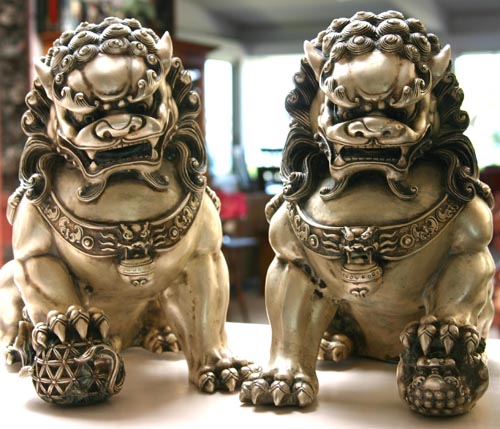 |
| A pair of guardian lion statues; the male on the left and the female on the right. |
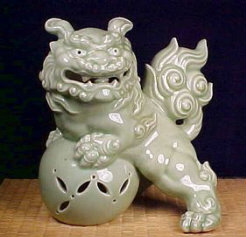 |
| Celadon Shishi |
Sources:
http://www.onmarkproductions.com/html/shishi.shtml
http://www.eons.com/groups/topic/1544693-Chinese-Foo-Lions
http://en.wikipedia.org/wiki/Chinese_guardian_lions
http://www.asianartmall.com/foodogarticle.htm
http://islandbeerclub.com/foodog.htm

Subscribe to:
Posts (Atom)